


How to Sew Knit Fabric Without a Serger: Complete Guide
Stretch fabrics · Complete guide with video
Sew knit fabric beautifully without a serger
Knit fabric curls at the edges, stretches out of shape as you sew and can leave a seam rippling like a lettuce leaf. None of that means you need an overlocker. With the right needle, the right stitch and a lighter hand, your regular sewing machine can sew stretch fabric with seams that are flexible, flat and strong.
Many sewists avoid knits because they believe a serger is essential. It is faster and trims the edge as it sews, but it isn’t required. Every stitch you need to make a T-shirt, a jersey dress or comfortable trousers is already on your domestic machine. The key is one simple rule: a seam in stretch fabric must stretch as much as the fabric around it. If it can’t, the thread snaps.
Quick answer: To sew stretch fabric on a regular sewing machine, use a ballpoint or stretch needle (75/11 to 90/14), polyester thread and a narrow zigzag stitch (width 1–1.5 mm, length 2.5–3 mm) or your machine’s stretch stitch. Reduce the presser-foot pressure, and let the machine feed the fabric without pulling it.
In this guide:
- Watch the video
- Know your knit fabric
- Prewash
- Cut without stretching
- The best needle for stretch fabric
- The best stitch for stretch fabric
- How to sew without wavy seams
- Stabilise shoulders and necklines
- Sew a neckband that lies flat
- Hem knits with a twin needle
- Pressing
- Troubleshooting
- FAQ
▼ Watch first
Video: how to sew stretch fabric on a regular sewing machine
This short video shows the three settings that matter most: the needle, the stitch and the stitch length. The rest of this guide covers everything around them, from cutting and neckbands to twin-needle hems.
More videos: Browse all our sewing video tutorials for other techniques, step by step.
▼ Before you start
Know your knit fabric
“Stretch fabric” covers very different materials. Some stretch because of how they are constructed (knitted loops instead of woven threads), others because of the elastane (spandex or Lycra) blended into them. Together, these decide how the fabric behaves under the needle.
The easiest knits for beginners
- Ponte (ponte di Roma): a thick, stable double knit. It barely curls, cuts cleanly and forgives uneven stitching. Ideal for a first dress or pair of trousers.
- Interlock: smooth on both sides and more stable than single jersey. The edges hardly curl.
- Scuba: thick and spongy, with a clean edge that doesn’t fray.
A manageable next step
- Cotton jersey with 5% elastane: the classic T-shirt fabric. The edges roll, but the elastane helps it recover its shape.
- Viscose (rayon) jersey: soft and beautifully fluid, but heavy and prone to growing as you sew.
Save these for later
- Very fine jersey or 100% cotton jersey without elastane: it stretches out and doesn’t spring back.
- Swimwear and activewear fabrics: slippery and very stretchy; they need a stretch needle and extra patience.
Two-way stretch vs four-way stretch
A two-way stretch fabric stretches in one direction, usually across the width. A four-way stretch fabric stretches both across and along the length. Your pattern will say which one it needs, and swapping one for the other can change the fit completely.
How to measure the stretch of a fabric
Before buying or cutting, check how far the fabric stretches. Most sewing patterns for knits list a minimum stretch percentage.
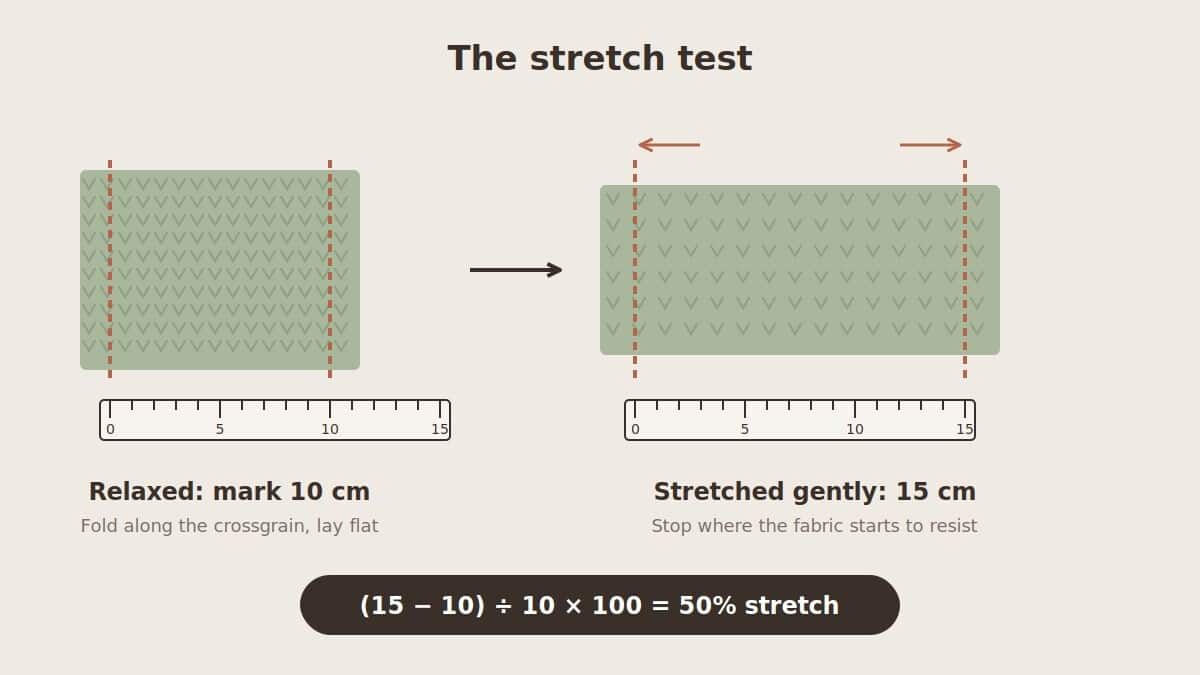
Fold the fabric along the crossgrain, mark 10 cm and stretch gently until you feel resistance. If 10 cm becomes 15 cm, the fabric has 50% stretch.
- Fold the fabric a few centimetres from a cut edge, along the crossgrain.
- Mark 10 cm with two pins.
- Hold the fabric against a ruler and stretch it gently until it resists. Don’t force it.
- Note where the second pin reaches, then let go. Does the fabric return to its original size? That’s the recovery, and it matters as much as the stretch.
Golden rule: If the fabric stretches less than your pattern asks for, the garment will be tight or hard to get on. If it stretches much more, size down or take in the side seams after a fitting.
Find a pattern for your knit: Every design in our sewing patterns for stretch fabric collection is drafted for knits, from the ETNA jersey top to draped dresses such as ALICIA.
▼ Step 1
Prewash your knit fabric
Knits, cotton jersey especially, can shrink considerably in the first wash. Prewash the fabric exactly as you plan to wash the finished garment.
Dry it flat when you can. A heavy wet knit hung on a line can stretch permanently under its own weight, especially viscose jersey. Tumble dry only if you’ll tumble dry the finished garment.
Remember: Some knits shed fibres in the first wash. Clean the lint from your washing machine filter, and later from under your sewing machine’s needle plate.
▼ Step 2
How to cut stretch fabric without distorting it
With a knit, the fabric can lose its shape before you’ve sewn a single stitch.
Keep the whole length on the table
Never let part of the fabric hang off the table. Its weight pulls the rest out of shape, and your pieces end up longer and narrower than the pattern. Fold the excess and keep it on the table.
Find the grainline on a knit
On knit fabric, the grainline follows the lengthwise ribs, the small columns of V shapes on the right side. Line the pattern’s grainline up with one rib and measure the distance to the fold at both ends.
Use a rotary cutter and pattern weights
A rotary cutter on a cutting mat is the most accurate tool, because the fabric doesn’t lift as it does with scissors. Pattern weights avoid the distortion pins can cause. If you do pin, keep the pins inside the seam allowance.
For edges that curl: A light spray of starch, pressed dry, keeps jersey edges flat while you cut and sew. It washes out afterwards. Test on a scrap first.
▼ Step 3
The best needle for stretch fabric
This is the most important change you’ll make. A universal needle has a sharp point that can pierce the yarn of a knit, leaving small holes that turn into runs after a few washes. It’s also the most common cause of skipped stitches.
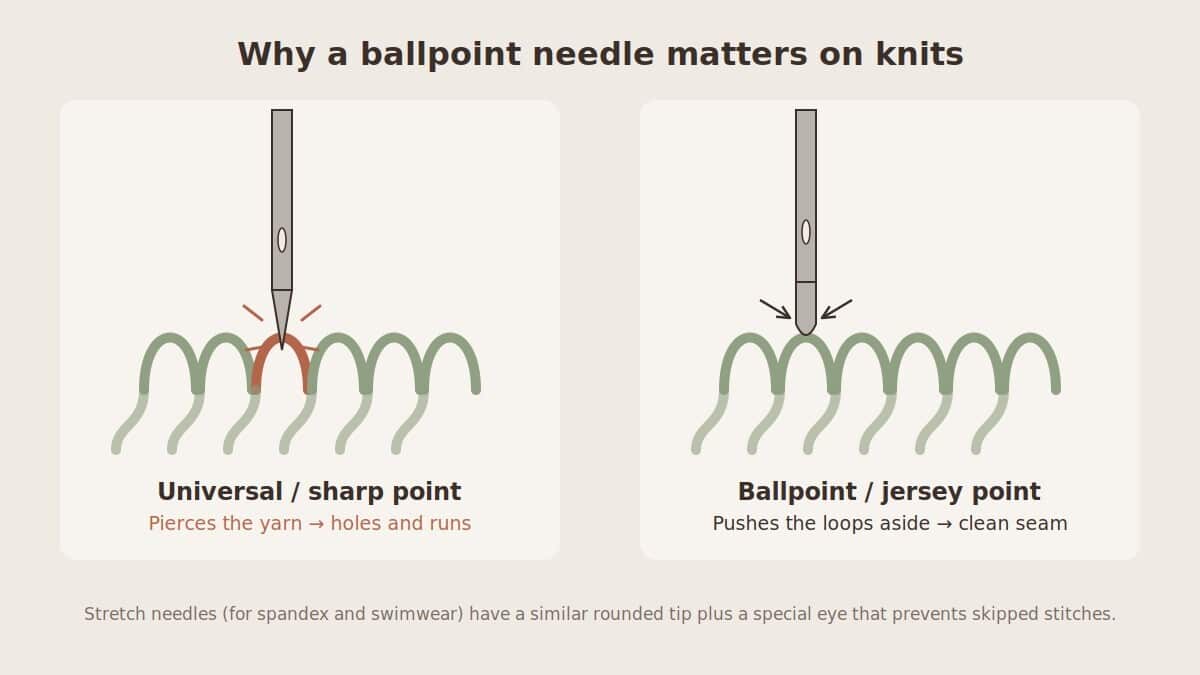
A ballpoint (jersey) needle has a rounded tip that slides between the knitted loops instead of piercing them.
| What you need | Starting point |
|---|---|
| Cotton jersey, interlock, ponte | Ballpoint / jersey needle: 75/11 for light knits, up to 90/14 for heavier ones |
| Knits with a lot of elastane (leggings, swimwear) | Stretch needle, 75/11 or 90/14. Its special eye helps prevent skipped stitches |
| Hems | Twin stretch needle, 4.0 mm |
| Thread | Good-quality polyester thread, which has a little give (unlike 100% cotton thread) |
| Presser foot | Standard foot, or a walking foot if you have one |
Remember: Start every knit project with a new needle. A slightly blunt needle is the number one cause of skipped stitches on stretch fabric.
▼ Step 4
The best stitch for stretch fabric on a regular machine
A normal straight stitch has no give: as soon as the seam stretches, the thread breaks. Fortunately, almost every domestic sewing machine has at least one stitch that stretches.
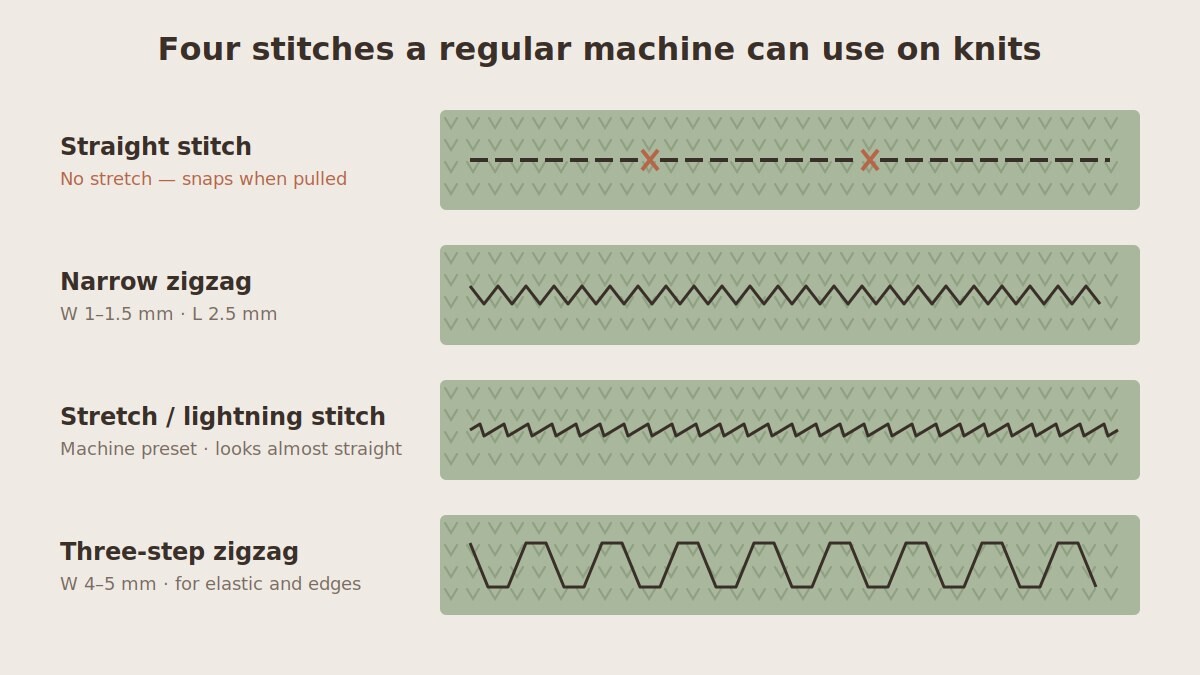
From top to bottom: straight stitch (avoid on seams that stretch), narrow zigzag, stretch or lightning stitch, and three-step zigzag.
| Stitch | Settings (starting point) | Best for |
|---|---|---|
| Narrow zigzag | Width 1–1.5 mm, length 2.5–3 mm | Available on every machine. Side seams, shoulders, sleeves |
| Stretch / lightning stitch | Machine preset | Seams that look almost straight but stretch. Leggings, fitted tops |
| Three-step zigzag | Width 4–5 mm, length 1–1.5 mm | Attaching elastic, finishing edges |
| Overlock-style stitch | Machine preset, if you have it | Sews and neatens the edge in one pass |
| Straight stitch | Length 3 mm | Only where the seam should not stretch, such as stabilised shoulders or basting |
A slightly longer stitch length (2.5–3 mm) means fewer needle holes per centimetre, which helps stop the seam from puckering or stretching out as it goes through the machine.
Test the seam before you sew the garment
Sew a 20 cm seam on two layers of your fabric, then stretch it firmly. If you hear small “pops”, the thread is breaking: widen the zigzag slightly or shorten the stitch. If the seam ripples, see Step 5 and the troubleshooting table.
Good news: Knits don’t fray. Most seams can be left unfinished, or you can zigzag the two allowances together and trim close to the stitching. No French seams or binding needed.
▼ Step 5
How to sew stretch fabric without wavy seams
Most problems with knits come from the hands, not the machine.
- Reduce the presser-foot pressure if your machine allows it. Less pressure means the top layer is pushed forward less.
- Let the feed dogs do the work. Your hands guide the fabric; they don’t pull or push it.
- Support the weight of the garment on the table so it doesn’t drag on the seam.
- Start slightly in from the edge and hold both thread tails behind the foot for the first few stitches, so the machine doesn’t pull the fabric into the needle plate.
- Sew at a moderate, steady speed.
Seen in the video: Watch how the fabric is guided without being pulled. The feed dogs move it, and the hands only keep the seam straight. Watch it again ↑
For fine or slippery knits: Place a strip of tissue paper or tear-away stabiliser under the seam. The feed dogs grip the paper, and you tear it away gently afterwards. It’s the same technique we use for sewing silk.
▼ Step 6
Stabilise shoulders, necklines and hems
Some parts of a garment should keep their shape, even in a knit. Shoulders carry the weight of the garment, and a neckline that grows ends up gaping.
- Shoulder seams: sew in a length of clear elastic, stay tape or a strip of selvedge along with the seam.
- Necklines and armholes without bands: staystitch them right after cutting, or fuse a narrow strip of knit interfacing.
- Hems: a narrow strip of fusible knit interfacing or hem tape makes twin-needle stitching much easier and prevents tunnelling.
▼ Step 7
How to sew a neckband on a knit top
A neckband that ripples or stands away from the body is the classic “homemade” look. The secret: the band must be shorter than the neckline it’s sewn to.
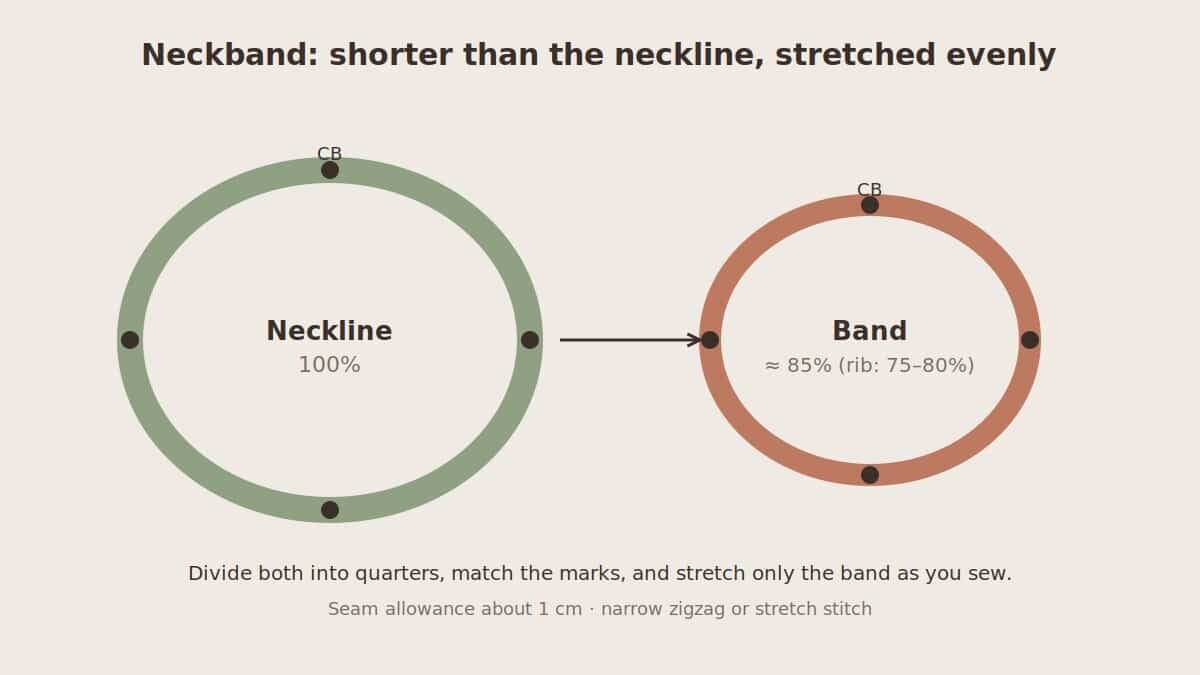
The band is about 85% of the neckline length (75–80% for rib knit). Divide both into quarters and match them before sewing.
- Measure the neckline along the stitching line, not the raw edge.
- Cut the band to about 85% of that length for jersey, or 75–80% for rib knit, which recovers better. If your pattern includes a neckband piece, use it: the proportions are already worked out.
- Sew the band into a loop and fold it in half lengthwise, wrong sides together.
- Divide the band and the neckline into quarters and mark each point with a pin or clip.
- Match the marks, with the band’s seam at centre back.
- Sew with the band on top, stretching only the band to fit the neckline between each pair of marks.
- Press the seam allowance towards the body with steam, and the band will settle flat.
▼ Step 8
How to hem stretch fabric with a twin needle
A twin needle makes two parallel lines on the right side and a zigzag on the wrong side, just like a shop-bought T-shirt. The bobbin thread zigzags between the two needles, and that gives the hem its stretch.
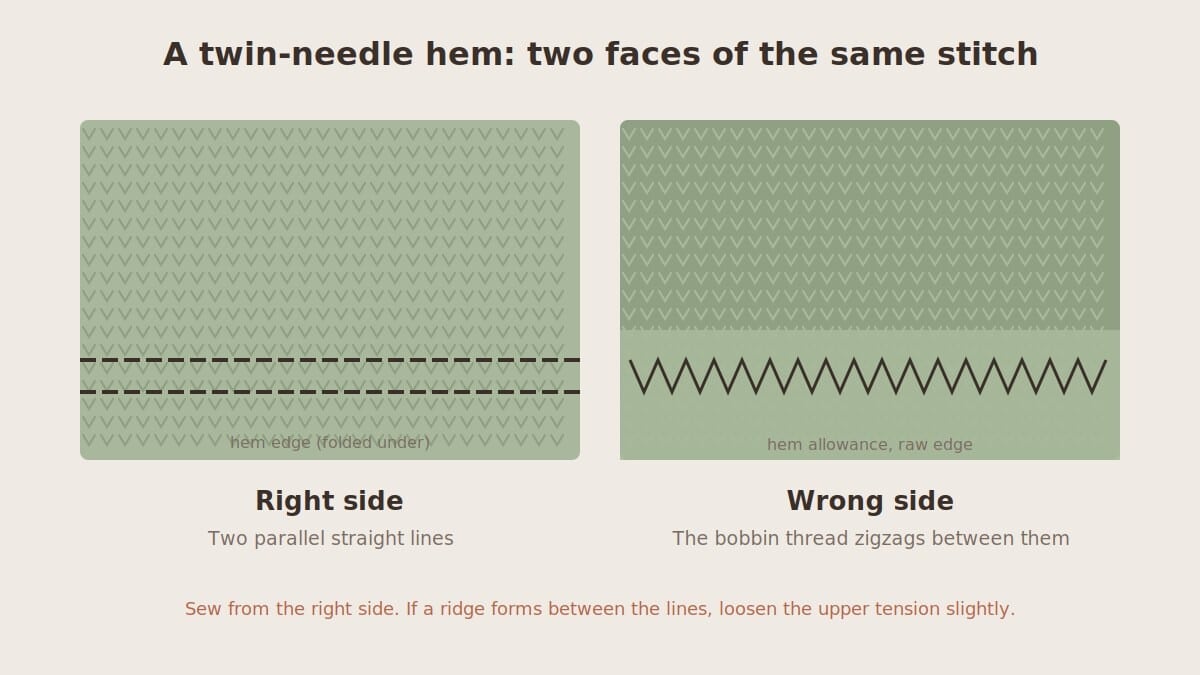
Two straight lines on the right side; a zigzag of bobbin thread on the wrong side.
- Fit a 4.0 mm twin stretch needle and thread both spools (your machine manual shows where the second spool pin goes).
- Select a straight stitch, length 3–3.5 mm. Never use a wide zigzag with a twin needle: the needles can hit the needle plate.
- Press up the hem allowance (2–2.5 cm) and stabilise it if needed.
- Sew from the right side, using a guide on the needle plate or a strip of tape to keep the line straight.
- Pull the threads through to the wrong side and knot them.
No twin needle? A narrow zigzag (width 1.5–2 mm, length 2.5 mm) or a stretch stitch also makes a good hem. Stable knits such as ponte or scuba can even be left raw.
▼ Step 9
Press, don’t iron
Lower the iron onto the seam and lift it again; sliding it back and forth stretches the fabric. Use a medium heat for synthetic blends and a press cloth for dark or shiny knits. Steam is your friend: it relaxes seams that have rippled slightly and shrinks them back to their original length.
▼ Troubleshooting
Common problems when sewing stretch fabric
| Problem | Solution |
|---|---|
| Skipped stitches | Fit a new ballpoint needle, or a stretch needle for fabrics with elastane. Rethread the machine. |
| Wavy seams (lettuce edge) | Reduce the presser-foot pressure, use a walking foot, lengthen the stitch slightly and stop pulling the fabric. Steam the seam. |
| The machine eats the fabric | Start slightly in from the edge, hold the thread tails, or place tissue paper underneath. |
| Stitches break when stretched | Switch from straight stitch to zigzag or stretch stitch. Widen the zigzag slightly. |
| Small holes along the seam | The needle is piercing the yarn. Use a ballpoint needle in a smaller size. |
| Ridge between twin-needle lines (tunnelling) | Loosen the upper tension slightly, lengthen the stitch and stabilise the hem. |
▼ Your first project
A realistic route into sewing knits
- Start with a cotton jersey with elastane: it’s forgiving and easy to find.
- Choose a pattern with few pieces and no closures, such as the TWYS top, which takes about an hour.
- Buy a little extra fabric to test needles, stitches and neckband proportions.
- When you feel confident, try a softer viscose or bamboo jersey with the ETNA top or the ERA dress.
- Then move on to a draped design such as the ALICIA maxi dress in a fluid viscose jersey.
Your first knit feels unpredictable because the fabric moves in ways a woven doesn’t. After one or two garments, your hands learn to guide instead of pull. You don’t need a serger to make comfortable, professional-looking clothes you’ll wear every day, just the right needle, a stitch that stretches and a little patience.
Frequently asked questions about sewing stretch fabric
Can you sew stretch fabric with a regular sewing machine?
Yes. Use a ballpoint or stretch needle, polyester thread and a stitch that stretches: a narrow zigzag, a stretch (lightning) stitch or a three-step zigzag.
Do I need a serger to sew knits?
No. A serger (overlocker) is faster and trims the edge as it sews, but a regular sewing machine makes seams that are just as strong and stretchy.
What is the best stitch for stretch fabric?
A narrow zigzag (width 1–1.5 mm, length 2.5–3 mm) works on every machine. If your machine has a stretch or lightning stitch, it gives a seam that looks almost straight but still stretches.
Can I use a straight stitch on stretch fabric?
Only on seams that shouldn’t stretch, such as shoulders stabilised with clear elastic or tape. Elsewhere, a straight stitch will snap as soon as the seam is stretched.
What needle should I use for jersey fabric?
A ballpoint (jersey) needle: 75/11 for lighter knits and 90/14 for heavier ones. For fabrics with a high percentage of elastane, use a stretch needle.
Why are my seams wavy when I sew knit fabric?
The fabric is being stretched as it passes through the machine. Reduce the presser-foot pressure, use a walking foot, avoid pulling and press the seam with steam.
How do I hem stretch fabric without a coverstitch machine?
Use a twin stretch needle with a straight stitch. It creates two parallel lines on the right side and a stretchy zigzag on the wrong side.
Sewing patterns for stretch fabric
Choose the pattern according to the weight and drape of your knit.
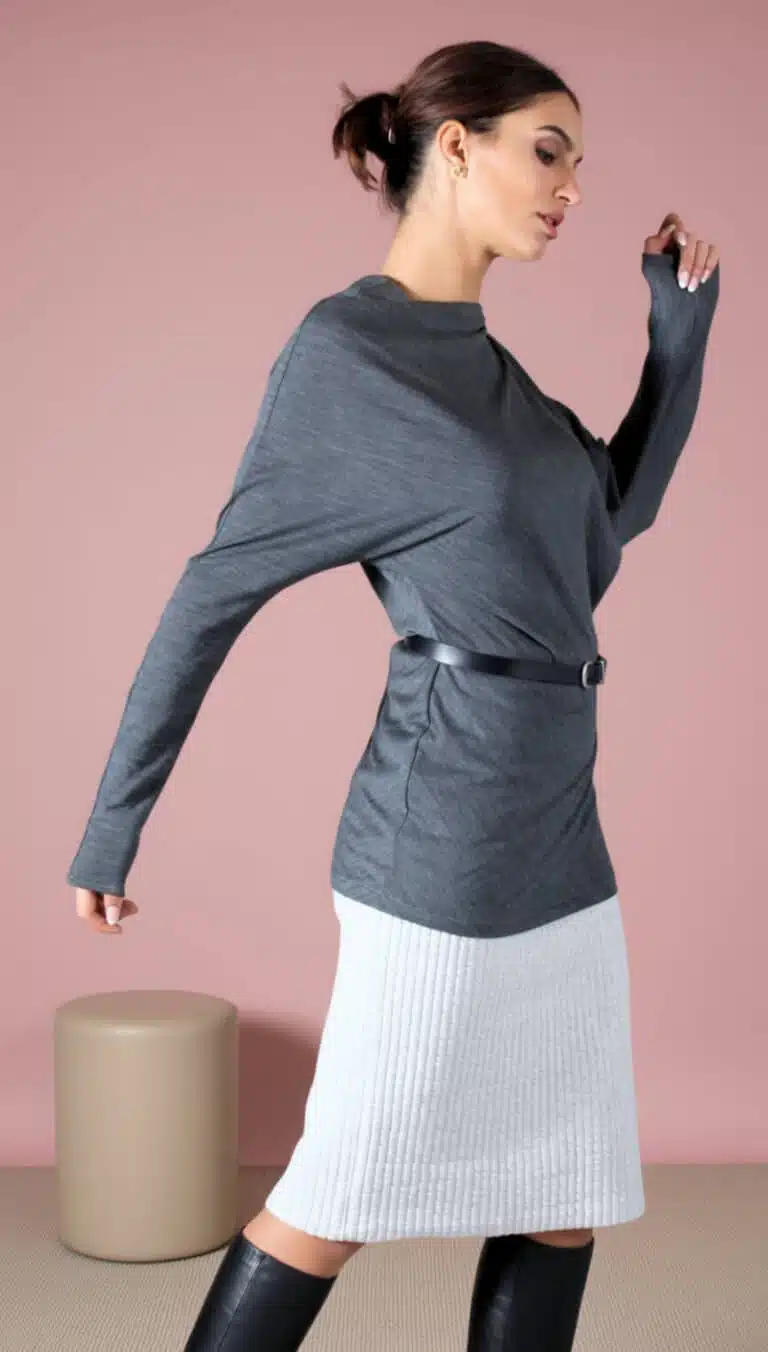
Very easy · Soft jersey
TWYS Top
A bias-cut long-sleeve top with an easy, flattering drape. About 1 hour to sew.
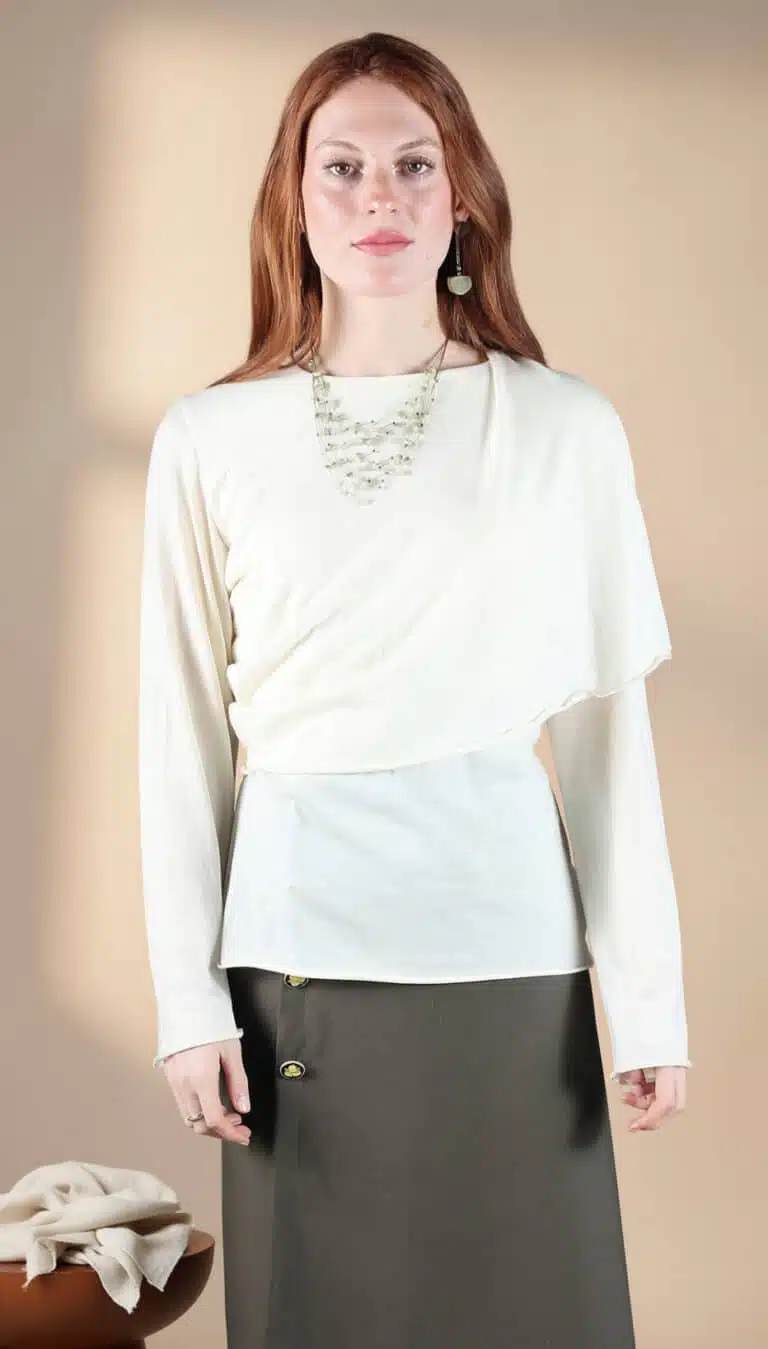
Easy · Fluid jersey
ETNA Top
A jersey top with a modern half-cape detail. About 2 hours to sew.
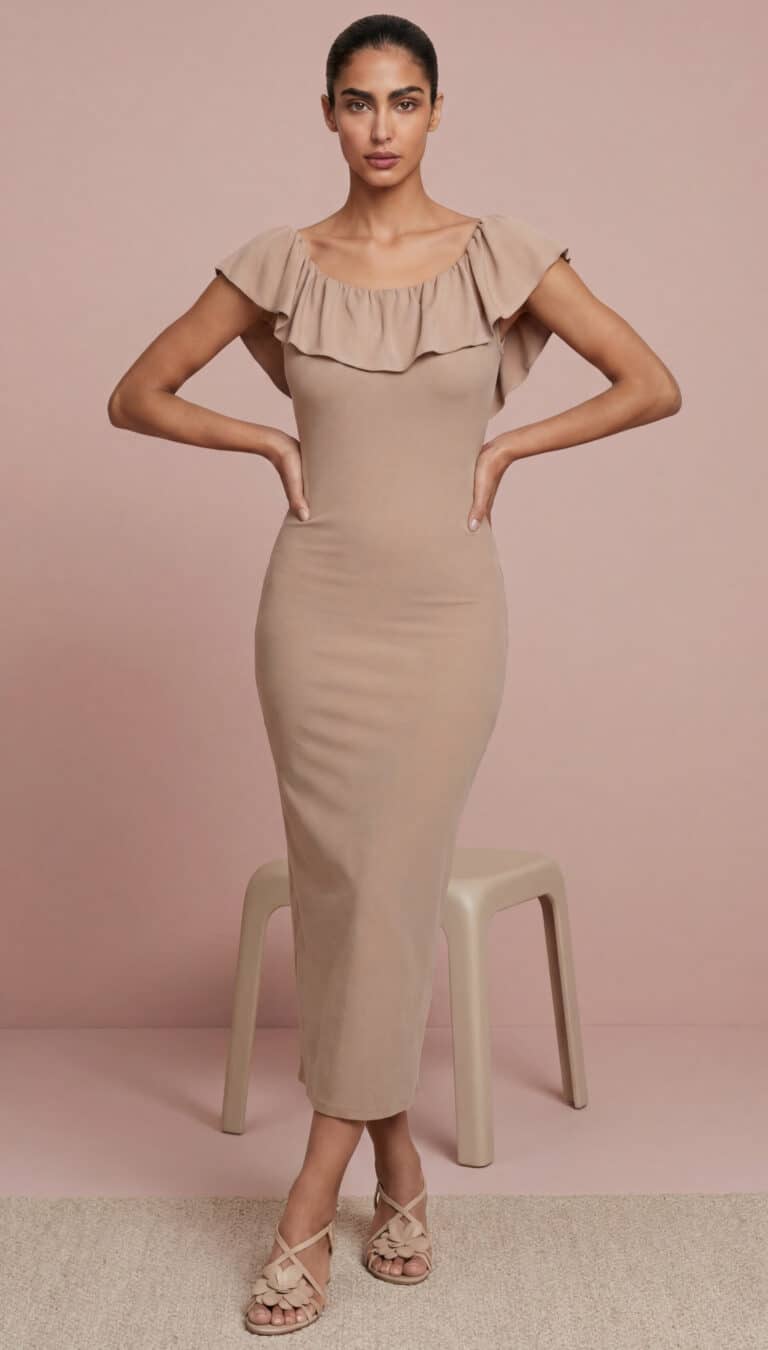
Beginner · Stretchy jersey (40%+)
ERA Dress
A fitted midi dress with a romantic ruffle neckline. About 2–3 hours to sew.
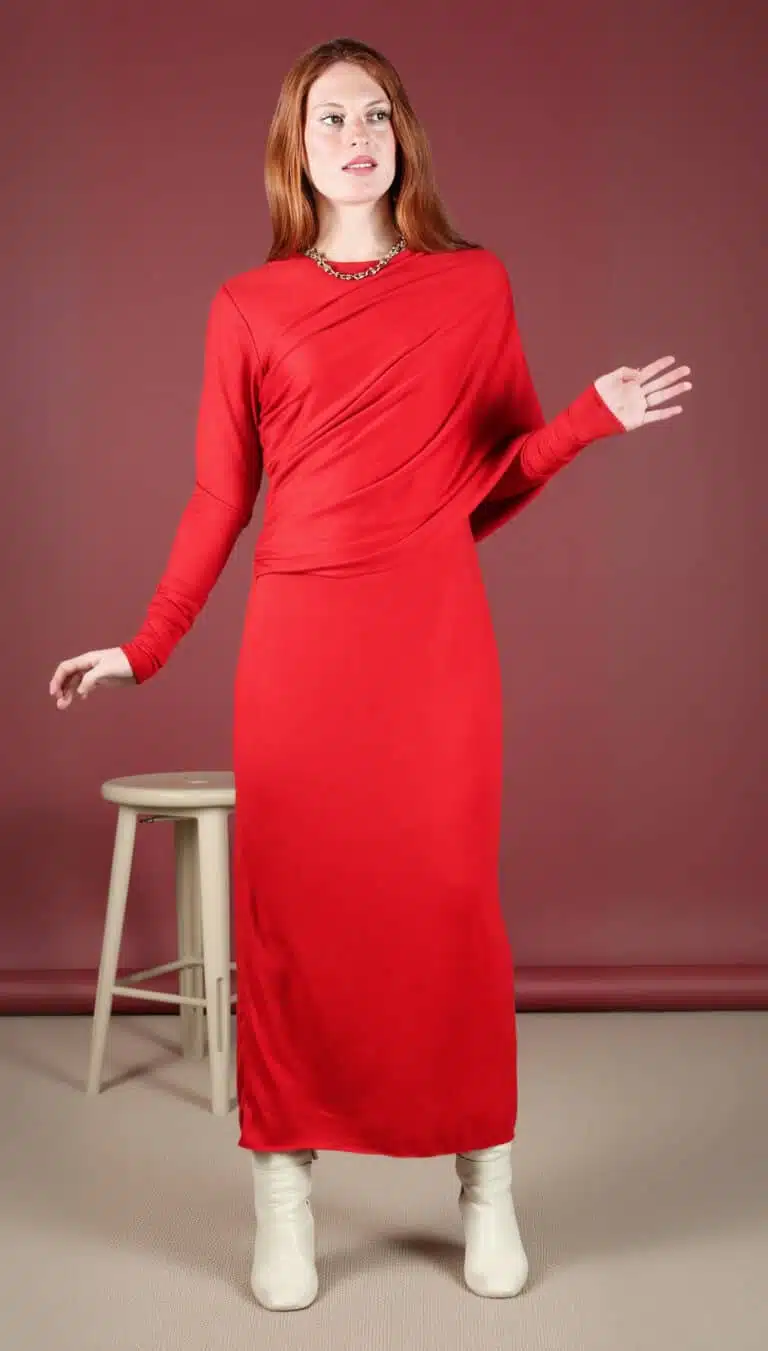
Easy intermediate · Fluid jersey
ALICIA Dress
A draped maxi dress with a half-cape and side slit. About 3 hours to sew.