


Ramie Fabric: The Complete Sewing Guide
If you’ve been searching for a natural fabric that is breathable, elegant, and kind to the planet — ramie deserves a prominent place in your sewing room. Ancient yet underrated, this plant-based fiber has been quietly waiting for its moment in the spotlight. And with the right PDF pattern, it truly shines.
In this article
1. What is ramie fabric?
Ramie (Boehmeria nivea) is a natural bast fiber extracted from the stalks of a flowering plant native to eastern Asia. Often called “China grass,” it belongs to the nettle family and is one of the oldest textile fibers known to humanity — used for thousands of years before cotton ever became mainstream.
The fiber is extracted from the inner bark of the plant’s stem through a process called decortication. Once refined, it produces long, silky, naturally white strands that are woven into a fabric with a distinctive linen-like texture and subtle sheen. In sewing communities, ramie is increasingly celebrated as a premium alternative to linen — offering similar breathability with added softness and luminosity.
“Ramie is sometimes called the ‘white gold’ of natural fibers — strong, lustrous, and naturally resistant to bacteria and mildew.”
2. A brief history of ramie
Ramie’s use dates back over 6,000 years. Ancient Egyptians used it to wrap mummies; Chinese dynasties wove it into fine court garments. For centuries it dominated Asian textile markets before cotton and synthetic fibers took center stage in the industrial era.
Today, ramie is experiencing a renaissance among conscious sewists and sustainable fashion advocates. As demand for eco-friendly alternatives to synthetic fabrics grows, this humble plant fiber is reclaiming its rightful place in the sewing world.
3. Key properties and characteristics
Fiber structure
Ramie fibers are exceptionally long — up to 50 cm — which gives the resulting fabric remarkable strength and a smooth, almost crystalline surface. The fiber contains a high percentage of cellulose (up to 76%), which contributes to its brilliant white color and natural luster.
Feel and drape
Expect a fabric that feels crisper than cotton but softer than raw linen. Quality ramie has a gentle sheen that catches the light beautifully, making garments look polished and intentional. Its drape is fluid without being limp — excellent for flowing silhouettes like dresses, tunics, and wide-leg trousers.
Weight and weave
Ramie is commonly available in plain weave, twill, or blended with cotton or linen. Weights typically range from 100 to 200 gsm. For garments, a medium weight between 120 and 160 gsm strikes the perfect balance between structure and ease of movement.
4. Why choose ramie? The advantages
Ramie stands out among natural fibers for an impressive list of qualities that make it ideal for garment sewing:
| ✓ | Exceptionally strong | Up to 8× stronger than cotton — your garments will last for years. |
| ✓ | Highly breathable | Perfect for warm climates and summer wear. |
| ✓ | Naturally antibacterial | Inherently resistant to mildew and bacteria — stays fresher longer. |
| ✓ | Brilliant color retention | Takes dye beautifully — colors are vibrant, deep, and lasting. |
| ✓ | Eco-friendly | Grows without pesticides, improves soil health, fully biodegradable. |
| ✓ | Gets softer with every wash | The more you wear it, the better it feels. |
| ✓ | Naturally lustrous | A subtle sheen gives every garment an effortlessly elegant finish. |
| ✓ | Hypoallergenic | Gentle on sensitive skin — a great choice for year-round comfort. |
| ✓ | Dries quickly | Ideal for travel and summer — no more waiting around. |
5. Stunning color range at Torretto Tessuti
One of the greatest joys of working with ramie is how brilliantly it takes color. Because the fiber is naturally white and has a smooth, light-catching surface, dyes appear particularly vivid and luminous — a quality you simply won’t find with cotton or synthetic blends.
The Ramie Armeno collection at Torretto Tessuti offers one of the most impressive color selections available — over 25 shades ranging from warm terracottas and spicy mustards, to cool navies, forest greens, and crisp naturals. Whatever your project, there is a perfect shade waiting for you.
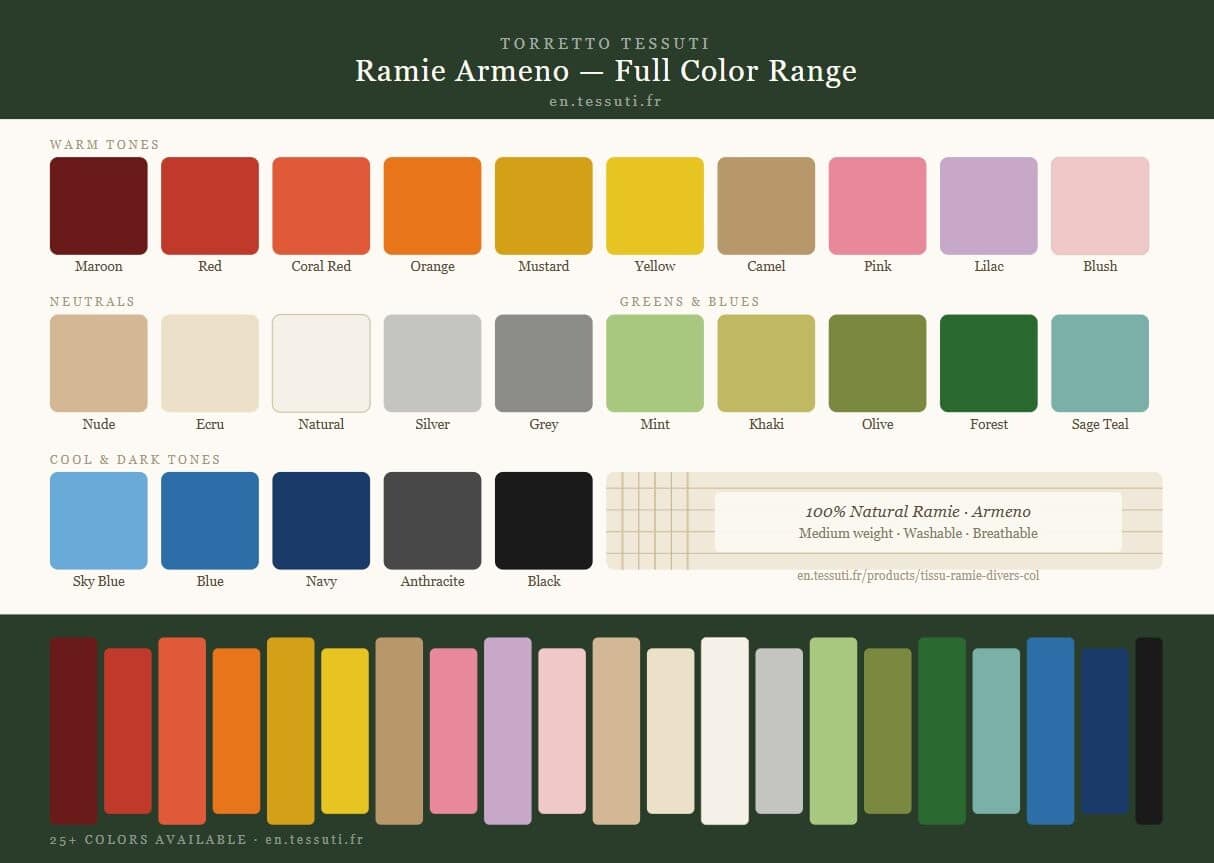
Find your perfect color
From rich jewel tones to soft naturals — all available by the 10 cm at Torretto Tessuti.
6. How to sew with ramie: 6 essential tips
Ramie is a joy to work with once you understand its personality. Follow these tips for the best results.
01
Pre-wash before cutting
Ramie can shrink around 5% on first wash. Machine wash cold or hand wash, then press while slightly damp before cutting your pattern pieces.
Ramie can shrink around 5% on first wash. Machine wash cold or hand wash, then press while slightly damp before cutting your pattern pieces.
02
Use sharp needles
A sharp or microtex needle (size 80/12 or 90/14) gives the cleanest stitch. Blunt needles push fibers apart rather than piercing cleanly, causing visible holes.
A sharp or microtex needle (size 80/12 or 90/14) gives the cleanest stitch. Blunt needles push fibers apart rather than piercing cleanly, causing visible holes.
03
Press generously
Ramie loves a hot iron with steam. Press seams flat as you go — this makes a dramatic difference in how polished your finished garment looks. Always press on the wrong side or use a pressing cloth.
Ramie loves a hot iron with steam. Press seams flat as you go — this makes a dramatic difference in how polished your finished garment looks. Always press on the wrong side or use a pressing cloth.
04
Finish your raw edges
Ramie frays at cut edges. Serge, zigzag, or use French seams to enclose all raw edges. Hong Kong finishing is particularly elegant with ramie’s smooth texture.
Ramie frays at cut edges. Serge, zigzag, or use French seams to enclose all raw edges. Hong Kong finishing is particularly elegant with ramie’s smooth texture.
05
Choose the right thread
Use a quality polyester or cotton thread that matches closely. Ramie’s light-catching surface makes thread color mismatches more visible than on matte fabrics.
Use a quality polyester or cotton thread that matches closely. Ramie’s light-catching surface makes thread color mismatches more visible than on matte fabrics.
06
Care after sewing
Hand wash in cool water with a gentle detergent, or use a delicate machine cycle. Hang to dry rather than tumble drying. Iron while still slightly damp for wrinkle-free results.
Hand wash in cool water with a gentle detergent, or use a delicate machine cycle. Hang to dry rather than tumble drying. Iron while still slightly damp for wrinkle-free results.
7. Perfect projects: Cherry Dress & Vienne Dress Sewing Patterns
Of all the garments you could make in ramie, a flowing summer dress is perhaps the most natural choice. The fluid silhouette allows ramie’s drape to do exactly what it does best — cascade elegantly, breathe beautifully, and hold its color brilliantly in every wash. Our Cherry Dress Sewing Pattern and Vienne Dress Sewing Pattern were made for this fabric.

PDF Sewing Pattern
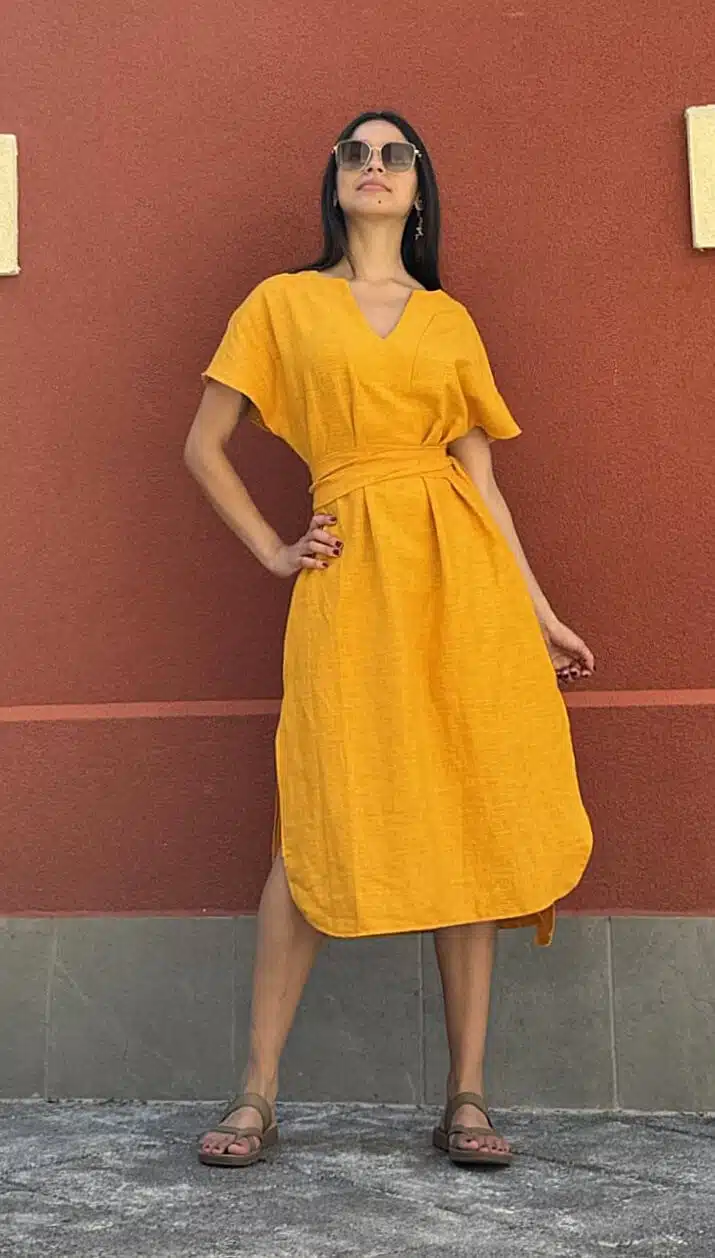
Cherry Dress Sewing Pattern for Women
An elegant, flowing dress with a relaxed fit, signature V-neckline with tab detail, batwing sleeves and a self-fabric tie belt. Beginner-friendly construction with a stunning result. Sizes XS–4XL included.
✓ Instant Download
✓ Sizes XS–4XL
✓ Beginner Friendly
✓ A0 + Letter/A4 Format
PDF Sewing Pattern
Vienne Dress Sewing Pattern for Women
A timeless fitted midi dress with delicate waist shaping, an invisible zipper closure, and optional lace band details at the front and waist. Easy intermediate construction with a polished, feminine result. Sizes XS–4XL included.
✓ Instant Download
✓ Sizes XS–4XL
✓ Easy Intermediate
✓ A0 + Letter/A4 Format
8. Where to find quality ramie fabric
Finding good ramie can be a challenge in mainstream fabric stores. For sewists who want both quality and a wide color choice, Torretto Tessuti’s Ramie Armeno is an outstanding option. This French-Italian fabric house offers a curated selection of ramie in an impressively broad color palette — each shade more beautiful than the last.
What makes their ramie special is the consistency of quality across all colorways. Whether you choose a soft sage, a warm ecru, or a bold cobalt, the hand feel and weight remain uniform — essential for achieving consistent results when following a sewing pattern. Available by the 10 cm, so you can order exactly what you need.
9. Frequently asked questions about ramie
Is ramie similar to linen?
Ramie and linen share many characteristics — both are plant-based bast fibers, both breathe well, and both develop a beautiful lived-in texture over time. However, ramie is stronger, more lustrous, and typically softer. It also holds its white color better than raw linen. Think of ramie as linen’s more refined sibling.
Is ramie sustainable and eco-friendly?
Yes — ramie is one of the most sustainable natural fibers available. The plant grows rapidly without pesticides or artificial fertilizers, improves soil health, and can be harvested up to six times per year. It is fully biodegradable at end of life.
Can I machine wash ramie garments?
Yes, with care. Use a delicate cycle with cold water and a gentle detergent. Avoid the dryer — air drying preserves the fiber. Iron while slightly damp using a medium-hot iron with steam for the best finish.
Does ramie shrink?
Pre-washed ramie will shrink minimally. Always pre-wash your fabric before cutting pattern pieces to account for any initial shrinkage, typically 3–5%. After that first wash, the fabric remains dimensionally stable.
Is ramie good for beginners?
Absolutely. Ramie does not slip around like silk or stretch like knits. The main consideration is fraying — finish your seams with a serger or zigzag stitch. Once that habit is established, ramie is one of the most enjoyable fabrics to sew.